




Milia: Causes, Symptoms, and Treatments
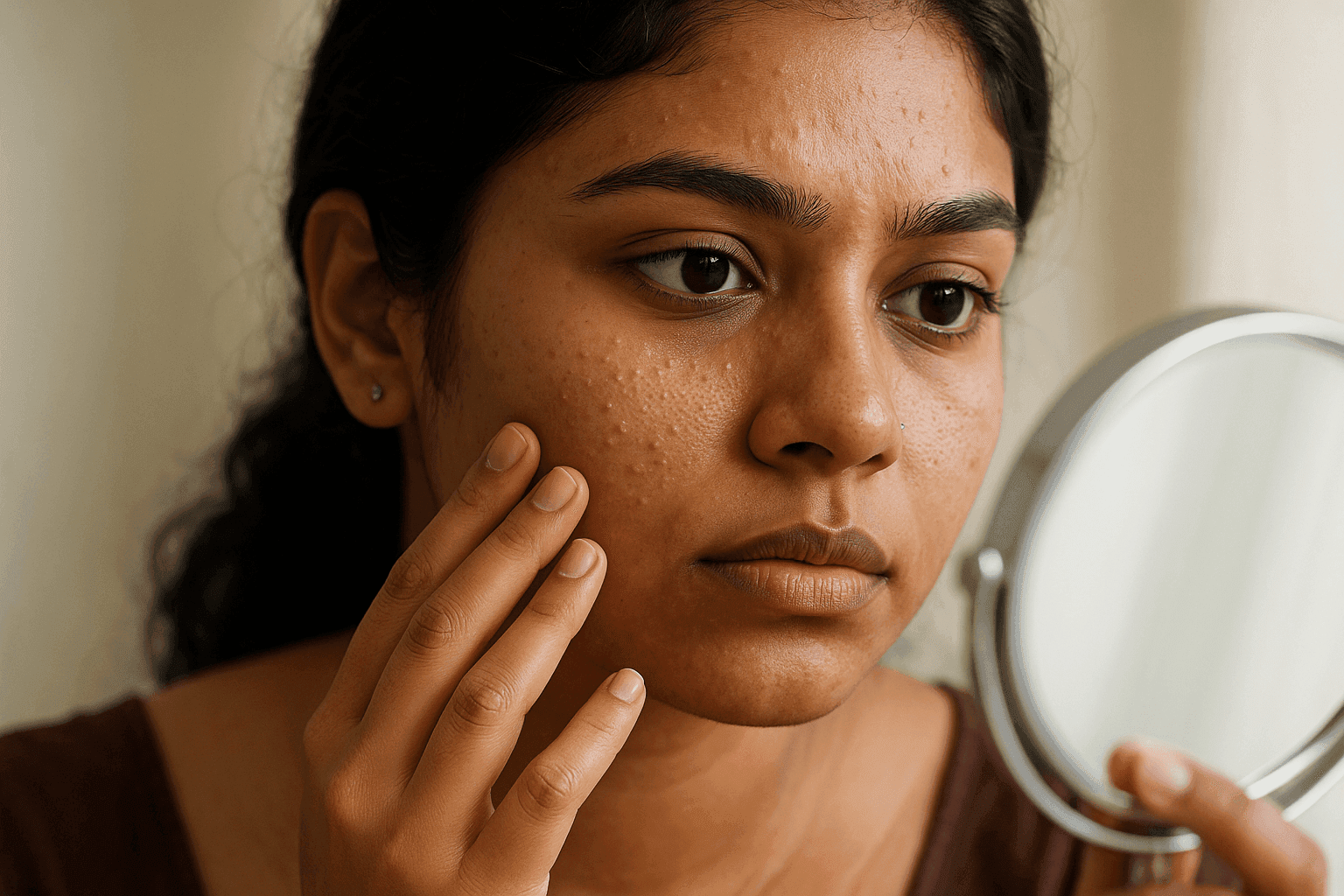
Milia are small white bumps that appear on the facial skin, are often harmless, and can be treated with topical treatments like retinoids or dermatological removal techniques.
Milia is not a serious condition, so there is nothing to worry about. It is often caused when keratin, the skin protein, is trapped under the skin surface instead of shedding. That’s why milia appear white and look like small bumps.
What is Milia?
When you spot small white bumps on your skin, it can feel confusing. You might be wondering, is it a whitehead, is it fungal acne, or is it something else? Many people generally assume that it might be a clogged pore or whiteheads, as the appearance is quite similar. But understanding what skin condition you are facing is the most essential part, as it helps you decide the right treatment.
If you are still not aware of: what is milia? Milia are stubborn and harmless white cysts that happen on your face, usually under your eyes and on the nose or cheeks. If left untreated, it may last up to several weeks or even months.
Here are a few simple steps that help you identify how milia is different from the pimples on your face. Let’s have a look at it:
- It does not contain pus.
- It does not cause redness or inflammation on your skin.
- It cannot be squeezed easily.
- It appears like small milky or pearl bumps.
What Causes Milia?
Even though milia is harmless, knowing its causes helps in preventing it. Some common causes of milia are:
- Buildup of dead skin cells can trap the keratin under your skin, resulting in milia.
- Using heavy skincare products like thick and oily creams can block pores and also trap keratin.
- Sun damage caused by chronic sun exposure usually thickens the skin, which can make shedding of dead skin tough.
- Skin trauma, like burns or blisters and injuries caused in treatments like dermabrasion or laser treatments, affects the skin’s outer layer, thus increasing the chances of milia.
- Ageing of skin slows down cell turnover and increases keratin buildup.
- Genetics can also be an important factor that causes this condition.
Types of Milia
Dermatologists have classified milia based on the patient’s age, the underlying cause, and how the cysts appear on the body. The main types of milia are:
Primary Milia
Primary milia is often caused when keratin gets trapped in the skin. This happens spontaneously and is not due to a reaction to any particular thing.
This is a common condition amongst newborns and can last for a few weeks.
When it comes to adults, they usually get it on their forehead, under the eyes, or on their cheeks. People observed that it lasts for up to some months.
The types of primary milia are:
- Congenital/ Neonatal milia - frequent in newborns.
- Benign primary milia of children and adults - this may require extraction from a healthcare practitioner.
- Milia en plaque - a rare variant found in middle-aged women.
- Nodular grouped milia - where multiple cysts are tightly clustered in a small area.
- Multiple eruptive milia - another rare variant where it spreads suddenly within weeks on the face, upper trunk (chest region), or arms.
- Nevus depigmentosus with milia - this is quite uncommon and occurs where you might have any existing patch of lighter skin colour.
- Genodermatosis-associated - these are rare genetic disorders that are usually inherited.
Secondary Milia
Secondary milia is often developed after a skin trauma, disease, or some medications, and lasts longer than primary milia. The types of secondary milia are:
- Milia caused by Trauma - when the skin layer is disrupted due to any accident or treatment that triggers milia.
- Milia caused by a disease - when you have a disease that affects your skin, and the surface of the skin is affected, it can sometimes result in triggering milia.
- Milia caused by certain medications - this happens when you apply certain creams, either prescribed for some condition or heavy skincare products.
Milia Symptoms
When people get any skin condition, the first thing they want before getting a diagnosis is to identify their problem based on the symptoms. While symptoms differ from person to person, not everyone will see all of them. Here are some common symptoms that can help you understand that you are facing milia:
- Small white or yellowish bumps
- Extremely small in size, hardly 1-2 mm.
- The texture is firm and hard.
- It appears smooth.
- They usually occur in groups or clusters.
- There is no inflammation or redness.
- They are often painless.
- They do not contain any pus and cannot be popped like a regular pimple.
Types of Milia and Symptoms
The symptoms that you face differ based on the type of milia you are facing. Here is a short overview of what the symptoms look like based on the type:
| Type | Key Symptoms |
|---|---|
| Primary Milia | Small, white bumps, firm, smooth, painless |
| Neonatal Milia | Common in newborns, usually harmless |
| Milia en plaque | Rare forms of patches of cysts |
| Nodular / Multiple Eruptive | Clustered bumps, sudden spread |
| Secondary Milia | Triggered by trauma, disease, or medicines |
| General Symptoms | 1-2 mm bumps, no redness, no pus, painless |
How is milia caused in babies?
Milia caused in babies is called congenital or neonatal milia. As newborns' skin is still in the development stage and cannot process many activities like basic shedding of dead skin cells. They are more likely to develop milia.
What causes milia in newborn babies is something that parents often wonder about. Newborn babies' sweat glands and hair follicles are still immature and not efficient enough to shed dead skin cells. You might have observed that they often have flakes on their skin.
It is quite normal to get milia as a newborn; in fact, there are studies that support 40-50% chances of milia occurrence in newborns.
Babies can get milia anywhere around their forehead, nose, cheeks, or chin. They usually do not require treatment and go away on their own.
If you spot any other symptoms in your newborn baby, it is best to consult your doctor before trying anything on your own.
Difference Between Milia in Children and Adults
Now that we know, milia in children is often caused by the fact that their skin is not developing completely. The reasons for adults are quite different and often require treatment for severe conditions.
Here are a few key differences that can help you understand the difference between milia in children and adults:
| Milia in Children | Milia in Adults |
|---|---|
| It usually occurs in the forehead, bridge of the nose, cheeks, chin, or inside the mouth. | It usually occurs near the eyes, or on the eyelids, cheeks, forehead, and occasionally the genitals. |
| It usually sheds away on its own within a few weeks, sometimes months. | The bumps stay for a long time and do not go away on their own. |
| To manage it, always get it diagnosed by a doctor. | Get it diagnosed by a doctor, and treat it either with extraction or other treatment suggested by them. |
Milia Treatment
There are many safe ways that help in treating milia. Some of the most common ways of milia treatment are:
- Dermatological Procedures like manual extraction, cryotherapy, laser treatment, or electrodesiccation are quick clinical treatments that are considered safe for the removal of milia.
- Dermatologically prescribed topical therapies or treatments like tretinoin, other medicated gels, or medical-grade chemical peels help in naturally pushing out the keratin and treating the cysts.
- Special medications for rare conditions include oral antibiotics or other medicines that work to reduce the condition.
Can I remove milia at home?
Milia is not a sign of any severe disease, and it stays for a long time if left untreated. Considering that fact, I know many people will get on how to remove milia, have the urge to pop it or pick it to get a clear skin, and try to find out ways.
So, just because it stays on your skin, do not try to pick it, as you would with your regular acne. They are painless and, in most cases, disappear on their own. They do not hold bacteria, oils, or any other particles that can be picked up. So, it is advised to be cautious with it and not try to harm your skin just for the sake of removal.
The best thing you can do is get it treated by a doctor in the correct way, rather than harming your skin with unnecessary attempts at removal.
How long does milia last?
Milia in newborns lasts for 2 to 4 weeks and usually clears up on its own. However, when it comes to adults, both primary and secondary milia last for months and even years. They do not go away without medical intervention.
If you are someone who is facing milia and wants to get rid of it, the wisest way is to get a diagnosis from your dermatologist and get the right treatment that suits your condition.
Home remedies for milia
Home remedies may not work for everyone. But consistent use can often help in improving your skin barrier and health, which may either help in reducing those bumps or getting them again.
A few home remedies for milia that gently treat it are:
Gentle cleansing
You can use a mild fragrance-free and soap-free cleanser. Make sure you are not harsh on the skin, especially on the spots where you have milia.
Facial steam
Getting steam for 5-10 minutes, as per your comfort, can often help in softening the surface of your skin. While steam alone does not help, it usually makes any topical treatments more effective.
Mild Exfoliation
You can use Alpha-hydroxy acid (AHAs) or Beta-hydroxy acid (BHAs).
AHA-based Exfoliation
Using a mild AHA that contains either lactic acid or glycolic acid can help in removing the dead skin cells and accelerate natural skin shedding.
- Do not use it more than thrice a week.
- Do not use it with any other active ingredient.
- Always ensure to add active ingredients by consulting a dermatologist or starting with a product with a lower percentage of active ingredients.
- A patch test is always recommended to avoid any reaction to the product.
BHA-based Exfoliation
BHAs are oil-soluble and penetrate deeper into the skin. Thus, it can help open the pores and remove the trapped keratin.
- You can use a salicylic-acid-based toner or serum as per your preference.
- Make sure that you do not use both toner and serum, or do not apply it with an AHA product, or any other active ingredient.
- Do not use it more than thrice a week.
- Always consult a dermatologist before using active ingredients in your routine, and do not experiment if you have sensitive or acne-prone skin.
Topical application of Retinoids
Retinoids are derived from Vitamin A, which helps in treating acne by accelerating the skin cell turnover. Retinoids range from retinol, adapalene, to tretinoin.
- Pregnant and breastfeeding women are advised not to use any forms of retinoid in their skincare.
- Retinoid makes your skin sensitive to UV, so it is important to use a broad-spectrum sunscreen if you are using it in your routine.
- Do not use a larger quantity of retinoid as it can cause redness, dryness, itching, irritation, and sensitivity.
- Start with a mild percentage of retinol, do not apply it during the day, and do not combine it with any other active ingredients. The best way to use it is with a dermatologist's recommendation to avoid any side effects.
It is important not to overlap any of these ingredients to avoid irritation of the skin barrier. Stick to gentle cleansing and consult your dermatologist before introducing any new ingredients.
Prevention of Milia
It is difficult to completely prevent milia; however, some good skincare habits recommended by dermatologists can significantly reduce the risk of getting it.
Here are some habits that can help in the prevention of milia:
- Avoid using thick moisturisers, oils, or heavy eye creams.
- Use non-comedogenic and lightweight moisturisers.
- Incorporate retinoid in your routine with a dermatologist consultation.
- Use BHA’s on 2-3 nights a week, when you do not apply retinols.
- Avoid over-exfoliation, as it can affect the skin barrier and also trigger milia.
- Wear a broad-spectrum sunscreen with a lightweight formula.
- Double cleanse your skin before sleeping if you use makeup, apply sunscreen, or live in highly polluted areas.
Clear Ritual’s Perspective on Milia
Milia is a mild condition that can occur on your skin either naturally or after a traumatic experience on your skin. This is quite common and often painless, which means you do not need to get anxious or worry about it.
At Clear Ritual, we believe that getting your skin health right, maintaining a healthy skin barrier, and overall skin protection with products that are recommended by a dermatologist can help you in preventing conditions like milia and treat it in the right way.
Your focus should always be on long-term skin health and not short temporary fixes that do not treat the condition correctly. Milia is manageable, unlike other skin conditions. A consistent skincare routine and the right dermatologist can clear it faster than you think.
Frequently Asked Questions
How do you remove milia?
To remove milia, you need to follow a consistent regimen of skincare along with dermatological treatment.
What is the main cause of milia?
Poor skincare or hygiene habits and trapping of keratin under your skin are often the main causes of milia.
Can you pop milia with a needle?
Unlike a regular pimple, milia does not have oil or pus. Milia does not have any soft points where you can prick with a needle. You might hurt the outer layer of your skin and even damage the barrier by using a needle. It is highly recommended to avoid using needles or any sharp objects to remove milia physically.
Can poor hygiene cause milia?
Yes, poor hygiene habits like using a dirty makeup brush, applying the serum applicator directly to your skin, or doing anything that can harm your skin barrier, or bad quality skin care products can often cause milia.
Will milia go away by itself?
In newborn babies, milia often goes away on its own. However, adults need dermatologist treatment to remove milia completely.
Can milia turn cancerous?
Milia is often considered safe and does not significantly show signs of any major disease, like cancer.
Which cream is best for milia?
Using non-comedogenic, fragrance-free, and light-weight moisturisers or creams is best for milia. If you do not see results with regular over-the-counter products, it is better to get a cream recommended by a dermatologist.
Is milia caused by a vitamin deficiency?
There are no studies or proofs that show milia is caused by vitamin deficiencies. However, using topical creams like retinol, which is derived from vitamin A, helps in boosting cell turnover and treating milia.
How to get rid of milia in 2 days?
If you want to get rid of milia quickly, you need to rely on dermatological procedures that are safe and guarantee faster results. However, based on the severity or type of milia, the time required to get rid of it completely varies from person to person.
Why did you suddenly get milia?
You might have used unhygienic makeup or skincare tools, or physically disrupted your skin barrier by either physical exfoliation or over-chemical exfoliation, which caused milia.
References
Editorial Standards
Clear Ritual has Strict sourcing guidelines to ensure our content is accurate and current. We rely on peer-reviewed studies, academic research institutions, and medical associations. We strive to use primary sources and refrain from using tertiary references. See a mistake? Learn More about our Editorial Standards.



